Thursday, 10 May 2012

Involving the Younger Generation

The Charity Commission has proved useful once again, and led me to a great hub of information on children being involved in charities and how it should be encouraged more.


Motivating the younger generation to work behind the scenes, allows them to have a voice and express their opinions on situations they wouldn't normally be involved in. This is a way of looking at 'giving children a voice' that I never thought about before. Give them a voice by making them a member of the team, instead of allowing their voice to be heard whilst being watched over and still judged. This way, they don't feel like they have to say what they think adults want to hear. They can actually fee comfortable with stating what they feel as they are working alongside adults.


"There are 180,000 registered charities in England and Wales, with nearly 850,000 trustees, but less than 4,500 of those trustees (less than 1%) are under 25."


Adding the views of the younger generation and taking them on board by implementing them within the charity brings a fresh look on certain issues and can create effective strategies never before thought of. Their input becomes valuable, especially if working within a children's charity because they can relate to the individuals the charity is helping. They are on the same level and are able to relate to feelings and experiences on a better level of understanding. A more accurate translation of what the children are feeling and trying to say can be made.


The opportunity to become a trustee becomes available if that individual has already been volunteering within the particular charity and already has a commitment to the cause. This is according to the 'Breath of Fresh Air' document released by the Charity Commission in 2010, with case studies enclosed, discussing what children felt who have experienced the role. This document also suggests that young people tend to go in to the charitable sector if they know people who are already involved, such as family and friends, or work/school colleagues. If they have no connection with charitable organisations then they are more often than not oblivious to the opportunities they can experience.


"...young volunteers were more likely to have engaged in some form of volunteering because members of their family already had an involvement... schools, colleges, universities and student's unions had played a key role... person's employer also played a part... people who are already engaged in some form of charitable activity... which stimulated their own interest."


Almost like Paying Forward the good deed; Adult encourages child to get involved in charity and say what they think on issues, child encourages children they are helping through the charity by pushing them to speak out on how their lives can be improved. In my case, this would be through artistic means. One person does a good deed, to then pass it forward to somebody else who needs help, and so on. It becomes a chain of positive energy. If you have seen the film 'Pay It Forward', then you will have a better understanding of what I mean in round about terms. A boy trying to make the world a better place. There is also a whole campaign dedicated to this strategy, which is followed world wide! 'Pay It Forward Day' "is about all people, from all walks of life giving to someone else and making a positive difference." It is incredibly interesting and well worth looking in to, but for the purpose of this Blog, I don't want to go off on a complete tangent and loose focus about what I initially started to talk about.... 'Involving the younger generation.'


Children bring enthusiasm, passion, motivation, understanding and willingness to help those who they can relate to. The easier you are able to out yourself in to somebody else's shoes, the more you want to help them. This is my opinion from what I have observed so far regarding who helps who.


I need to speak to White Stuff again and find out more about their trustee role. If I continue to show my interest and can prove to them that I have knowledge about what they stand for, they are more likely to consider me if another position appears. Fingers crossed.


What charity would I become a board member on if I had the choice? Why?
These are questions I need to begin to ask myself. My campaign will be a lot more effective if I can begin from inside the organisation and already have experiences with them.

The Charity Commission

Everything you need to know about charitable organisations is on this website, from setting up, how to be success, finance/fundraising, details of all registered charities and so on. It is vital that you are knowledgable on the sector and that you are clear about all topics surrounding the Charity Commission. It should have been the first topic of research I carried out instead of using it as and when I needed it. I have to admit, the reason I kept putting it off is because I knew the vat amount of information I would have to sift through, and this made me a little reluctant as I stress about information overload already! I might have made knowing where to look for information a lot quicker and easier if I had just dived straight in.

If you are a charity, by law you have to go through the Charity Commission to register, and follow all of their strict rules and regulations; of which there are many! The public have access to this site and are allowed to view annual statements and finance papers. It is vital and compulsory that the charity keep their page up-to-date and ensure all information submitted is 100% accurate.


Since the article 'Things to think about before setting up a new charity' (Date published unknown), the number of registered charities has changed. The article states that there were around 180,000 in England and Wales at this point in time, whereas on the website home page today (10/05/2012), states there is 162,277 currently. This shows a drop in the number of organisations registered now. Could this be to do with all the government caps and methods being implemented at the moment?


The C.C are also there as a support team for the organisations, and will do everything they can to ensure as much helped is given as is needed.

I am not looking to set up a charity, but I do want to read as much around the sector as possible to see how they work, where their income comes from and what their expenditure is like, money making ideas, and so forth. The more information I can get and the better understanding I have, the more successful my campaign/event will be because I'll know what to spend money on, who to target, how to promote effectively, what to avoid etc.

As well as this site carrying a wealth of knowledge, it has links to other valuable contacts and areas of interest. I could do a whole module on the amount of information produced from this one site. The danger is discovering too many avenues and deviating off down them by loosing focus. I need to focus on what it is I want to achieve and skim over topics of interest that aren't necessarily relevant at this particular moment. I can always come back to them in my own time and have a more in-depth look.


A section I came across gave information on company sponsorships. It is specifically related to charities applying, but are points I can take on board and adapt to make it relevant to myself. A company is more likely to hop on board my campaign if I have a strong strategy and plan behind it. If they have the belief in you and what your aims are, they will want to contribute. Your relationship with the public is a vital aspect they look in to as well, because they want to reach an audience too. If you have a support group following you, the company know you are legit and passionate, and this will make them more inclined to invest. They need to insure that you will be benefiting them, as well as vice versa. Reputation is key. would you invest in somebody who isn't likely to succeed or gain a good reputation? You also need to believe in the cause they are promoting. Once you sponsor somebody, your names are linked and an association with each other is created.


I need to get companies on board to sponsor my campaign/event to raise its profile. I am more likely to succeed if I target companies that could possibly benefit from being associated to me. Their profile raises as well, and they become more trustworthy because they are viewed as charitable. Education based companies? Art related? Etc. These need to be thought about in more detail and research in to the local area has to be done. Local companies are more likely to come on board than national ones.


"I want to fundraise for a charity, how do I go about this?"
I need to know what charity I am linking my campaign to in advance in order to set up a communication with them. It needs to be perfectly clear what my intentions are and how everything will be documented for them. The charity may even be able to aid me in some of my processes and planning, or take the campaign on board more seriously and allow me to work with a team of people within the charity already. Before all of this can be made in to reality, a plan has to be formed on my part with clear points of what I propose to achieve from the project and my reasoning behind it. Support from the charity will allow me to achieve so much more than I could do on my own. Having a network of people is a massive advantage and crucial in most situations. If the charity approve of what I intend to do, they will give me permission to use their registered charity number and this will be a huge advantage to me because it instantly raises my profile and shows the public that I am for real.

Monday, 7 May 2012

Lack of Information...

As soon as I saw the opportunity to go to India, I jumped at the chance! It isn't often you get a once-in-a-lifetime activity like this fall at your feet. The thought of doing something that could be life changing overwhelms you with excitement. All you have to do is raise money and hit a target set. You're doing it for charity, so even better! And it's not going to cost you a penny because 'everything is included'. 

LETS DO IT!

And they've got you.... Did you read the small print or were you too exhilarated at the fact that you're actually doing it. You're going to India! Think of all that exercise, the heat, the food, the children you'll be helping to 'unlock their potential'.


£245 sign-up fee, which you don't get back if you drop-out. (You are informed of this).

£62 Travel Insurance.

£52 Visa.

£400 Vaccines.

Transport costs to Airport and back.

Deadlines throughout the year (you don't reach it, you don't go).

The charge BTDonate ask, to allow the charity to use their fundraising pages.


Bet they didn't tell you all of that when you read 'everything is included'....

I bet you didn't even consider these things on your spur of the moment decision....


These are additional costs that weren't in the Welcome packs or the information on the website when you are reading the advertisements to join. When they say that all will be included, this is what I assumed they meant. I had every intention of paying a lot of the additional costs myself so they money I raised went to the charity and not to getting me to India, but it would have been nice to be informed of how much all the 'additional' costs would be, or even that they would be extra on top of the target. It comes as a bit of a shock when you can't afford the prices you need to pay. A lot of people end up dropping out (at the last minute in some cases). The charity keep all the money you have paid in so far but don't need to worry about covering the costs of your flights/accommodation/food/etc anymore, so you have done them a favour and donated money to them, without the need to pay anything out at their end. 

20 people signed up to cycle around India with me originally. Everybody paid their £245 upfront, and a lot started to fundraise. 6 of us remain. This means, the charity have been donated a lot of money and don't need to spend any of it on the challenge takers. They know that the amount of people who actually take part in the challenges, will never be as high as the number of people who sign-up initally. They grab you and draw you in, before you realise that you're spur of the moment decision may not have been as realistic as you once thought.

Luckily, I haven't had this problem. I knew instantly that it was what I wanted to do, and I have stuck at it and spent a lot of time and hard work fundraising to collect more than what the target it. £2450 is what the charity say is the minimum you have to have before you are allowed to go. I put my target at £3000 in the hope that I would raise that much. Where I stand at the moment, I have just over a month to go before I take-off and I'm not far from my target of £3000. As well as the challenge I face ahead of me, I am very proud of completing the challenge I have had to face at home by raising all the money. It does take up a lot of time though and this is another way people end up dropping out. They don't realise at the beginning how much time will need to be invested in hitting the target fund. It begins to get closer to the deadline and they suddenly realise that they aren't going to reach it. The charity then inform you that you're not able to go because you haven't reached the required target in the allocated amount of time. 1-0 to the charity.

What I believe the charity should do is, include a link of their website where it tells you all of the things included and all of the things not included. In my personal opinion, I think more people would probably sign up because they would be fully aware of everything. A few people are wary of signing up to something (especially if there is a deposit), without as much information as they can possibly get. This information would also stop straddlers applying and dropping out. the charity would loose out on the non-refundable deposits, but they would gain challenge takers who stay the full-length and end up raising a lot more money for them.

If I had known about all the additional costs I would be faced with, it wouldn't have stopped me from applying. I would have maybe post-poned for a year and fundraised within my own time in order to collect more money and the chance to save up to pay the extra costs, but I wouldn't have ever not taken the challenge. It has been an exciting journey already from the day I clicked the submit button and I know that they journey isn't going to stop when I get back either.


I haven't included any names of charities so I am not specifying it down to one organisation, but I have based it around my experiences.

'Chuggers'

I've been doing a lot of research on face-to-face fundraisers lately as I wanted to look down all the avenues that charities take to get supporters and donors on board. People stopping me on the street is something I have always been confronted with, coming from a big city like Birmingham. I am the kind of person that spots the fundraisers in advance and crosses the road, or walks very fast past them stating I am in a rush. It made me feel bad when I did this, but now I have read in to the topic, I am going to have no problem waking straight past them. I was shocked at what I discovered.

Newsnight carried out extensive research in to what the public have labelled 'chuggers' or 'charity muggers'. These fundraisers are employed by charities from external firms, so there isn't a direct link between the individual trying to sign you up and the cause they are promoting.
The fees charities pay out to these firms often 'wipe out the amount an average person gives each year.

An example of this can be seen in the British Heart foundation Interview on Newsnight (2010), and back up online articles, where it explains £136 is given to the fundraiser for every signature they manage to get. On average, a donor gives £90 a month in donations. This means that if the donor signed up on the street, unless they are giving money for more than 18 months, their money isn't even reaching the charity because they are paying the external firms fees with which they signed up. This is all very well if you can guarantee you have just got a life-long supporter and keen donator on board. There isn't any way of making sure these individuals stay with the charity for the years to follow.

Reporter Gavin Elser asked Betty McBride, the director of policy for the British Heart Foundation, "...But do they say that they will receive an average of £136 to sign somebody up who in the first year may only pay you £90. That's where people are not being naive, they expect you to have overheads, but also expect you to put as much as possible in to the charity..."
McBride came back with an answer that in my opinion wasn't satisfying enough and didn't make me accept external firms anymore than I already did. She said that their website has information displayed about paying professional fundraisers for face-to-face activities. In their annual review, they also have a section about what percentage of the charities costs go on fundraising. McBride claims that 'about 70% recruited by telemarketing are still with the charity 5 years later'.
Surely you need to know in the first place that external companies are being used in order to know to look on the website? If you are unaware of this, then you have no idea that your donation isn't going directly to the cause you are 'supporting'. I unfortunately fell in to this trap and looking back now, I wish I had been given more information and I feel anger towards the charity as well as the fundraiser, for not informing me where me money was going. When you give your signature to support a charitable organisation, that's where you expect your money to go. You don't think about asking questions! The trust is there. Well it shouldn't be and where possible now, I aim to stop as many people using face-to-face fundraisers as possible. I was stopped in the street by 'Care International', who I had been reading about for some time. I signed up there and then thinking it would save me the hassle of doing it any other way and I also thought I was doing something good by speaking directly to a member of the charity who knew everything about it. I couldn't have been more wrong. The initial signature sign-up was followed by a phone call. I have been a regular donator now for many years. I had no idea all those years ago, that the first 18 months of donations were in fact not even seeing any of the charities projects, and going straight in to the pocket of the company that signed me up. If I had known all of the background information beforehand, I would have gone straight to 'Care International's' website and signed up directly, avoiding the unnecessary middle-man. 


  Care International face-to-face external fundraisers


According to a survey I came across on street collectors, two-thirds of people will cross the road to avoid being pestered.

Intelligent Giving published findings which shocked and disgusted me when I came across them:
- Fundraisers earn about £8.50/hr. 
- 20% of the 50 'chuggers' studied had no ID. 
- 25% of the 50 didn't even know who they worked for.

These are the people you giving money to and the people who are allowing you to think you're helping an amazing cause. 

They are an "inefficient way of giving and they give charities a bad name and they harass people and put them out - and we think that's behaviour charities shouldn't be indulging in." - Intelligent Giving.

There many people who back-up this method and state that face-to-face fundraising using external firms is a good idea and it has a great benefit to the income being received for the charitable organisation. Mark Aldridge, chief executive of the Public Fundraising Regulatory Association confesses that fundraisers can sometimes be 'over enthusiastic' and pushy, but they are well trained and committed. This may be the case, but is that really something you want to pay for? You want them to be genuinely happy that you are supporting a cause/issue, not happy because you are lining their pockets. In my eyes, I only see them as being enthusiastic and 'in your face' because if they don't get a certain amount of signatures in one day, they don't get paid, or as much money as they could. So, not for your benefit, but for their profitable benefit.

Oxfam pulled out of using this strategy because they feared it would damage their relationship with its supporters. Many other charitable organisations have followed suit. But Great Ormond Street Hospital stand by the technique stating that it "proves to be an effective channel at recruiting younger committed givers to the charity." Is this because the younger generation are more naive to what happens in the background and donate because they want to 'do a good deed'? Or because they are easier to pressure in to donating when confronted on the street? These are questions I asked myself instantly. I know that I feel really bad if I say no to people and this may be the case in a lot of younger people, especially females.

This method of fundraising wouldn't be as popular of beneficial if the donors were informed before they signed anything, that the fundraiser is being paid £x amount of money and that their donations won't see the charity causes unless they are a long-term donor. Many individuals would go direct to the charity instead. Or maybe not bother donating at all? This is another problem you could be faced with.


When it comes to my campaign and promoting my cause, all the fundraisers I use (if this is an avenue I go down), will be able to gain job perks but will work for me directly and not for huge profits like £136 per donor!! They will also have to support the cause and know as much about it as possible. The presence people see on the street won't be running up to you and trying to get you to part with your money. I will have my fundraisers/promotors handing out leaflets with information about my cause, ways to support if they wish to do so, and events that can be attended. This is a much better way to go about gaining supporters in my view because if I was approached in this way, I am more likely to take notice and find out more in my own time. I would even attend some of the events to see what they are about. Then I can make up my mind. But by then, I have done the charity a favour by talking about them, inviting people with me to the events and possibly donated already.

Photos That Changed The World.... 1


I only picked up this book as light reading whilst eating my breakfast. It didn't occur to me that it may be useful! Flicking through the pages, there are some fascinating images and some that I knew instantly as iconic photographs. It wasn't until seeing Lewis Hine's image (Pg. 16), that his series on Child Labour came flooding back to me. I don't know how I hadn't thought about him earlier! He is one of my photographic inspirations and it never occurred to me that his projects will link in with what I am researching. 


©Lewis Hine

"Sadie Pfeifer, 48 inches high. Has worked half a year. One of the many small children at work in Lancaster Cotton Mills. Lancaster, S. C., Nov. 30, 1908."


The large machinery surrounding the small child shows just how vulnerable she is and that industry isn't a place for young children. If I saw this as part of a campaign, it would anger me that such labour exists. Hine is able to engage his viewers and make them feel a range of emotions. Additional power lives behind the photographs because he has experience in the situations he captures; working in an upholstery factory, 13 hours a day, 6 days a week. Being able to live through the individual in your images, gives more of an impact because your image portrays the situation with more realism, you can really get in to how the girl is feeling and what the conditions are like. What would the images look like if Hine was simply an outsider? Being able to relate to the experiences, gives a personal touch.

Hine uses the photographic medium to 'educate' people. I hadn't considered looking at it this way and I really like this terminology to describe using images to make people aware of issues. He also gave lectures on the topics close to him, further educating people with the back-up of words alongside his images. Organising people to come and give talks during my campaign to highlight the issues I am raising, is something I need to look in to. It is a great idea to have more than one platform of communication.


Page 48 made me come into contact again with a photograph I have seen and studied many times over the past 4 years. I don't know many people who haven't seen this image before (may be because most of the people I know are photography related?).


© Dorothea Lange
Migrant Mother, March 1936, Nipomo, California


In my opinion, how Lange has framed the image changes the impact. Would your view and feelings change if you could see the tent they lived in at the Pea-pickers camp? Would it make you 'pity' them more?

The black and white works well for this particular image and the message being portrayed. You aren't being distracted by the colour palette, the context and the subjects are focused on. This is what I believe, others disagree and say that you need the colour to show the realism. In a lot of cases, I wouldn't argue this, but in this instance, I stick to the success of black and white imagery. 

One of the things I admire about Lange's Migrant Mother image, is the ability to provoke feelings within the viewer without the need to shock and disgust them. The image isn't of a positive scene, so you can see suffering, but it isn't making you feel guilty. You are empathising instead, feeling sorry for the lady and children present. Seeing the two children buried into the shoulders of this thoughtful looking woman, tugs at my heart-strings.

In the book, there is an article accompanying the photograph, highlighting and informing the reader about the situation the image derives from. With a photograph like this (if being used for campaigning or raising awareness), needs the additional information sitting next to it. There is power within what you can see, but being knowledgable on the situation gives the image more of an impact. The paragraph simply emphasises what you are viewing.

On the subject of books, Lange's series of images were made in to a book. This targets a completely different audience and is another way to get the surrounding issues raised. The photographer is no longer commercial, they become a social documentarist; bringing the Artistic world in to the equation. So, as well as targeting people who you want to donate, raise awareness too and make a difference, you are reaching out to those who are artists/photographers and art sector enthusiasts. I know many people who love photographs similar to Lange's and have created a collection of books full of social documentary images. These people aren't interested necessarily in the cause or the 3rd sector, they are interested in the photographs themselves. They are still contributing to the cause by purchasing a book, but not through deliberately donating.

As a photographer, you always want to appeal to the Art sector and get their interest on your side. I know this is the case with me. A book is something I have been certain on from the beginning. My images will be collected up and presented in a printed publication aimed towards the Art market. A booklet will be produced alongside the book, which can be handed out to everybody. The book will be an Art piece to be produced and purchased on request.

Just image owning a limited edition of a book which includes a series of photos from one specific photographer that 'changed the world', and knowing that by purchasing the book, you contributed by funding the organisation helping the cause.

"Photographs were important tools in convincing legislators to aid poverty-stricken Americans" (Pg. 48)

The sentence above backs up my view on how important imagery is in getting the attention of the public. In fact, I believe the are vital. You can't look anywhere without seeing images (moving/still). When using them to campaign, you aren't simply targeting the public to make them aware and to hope they will help with donations and volunteering, you aim to grab the attention of individuals higher up on the scale who can make the massive differences. This is where I am going to open up my campaign/event to local (or international if necessary) people who I consider to be important and possible beneficiaries to my cause.


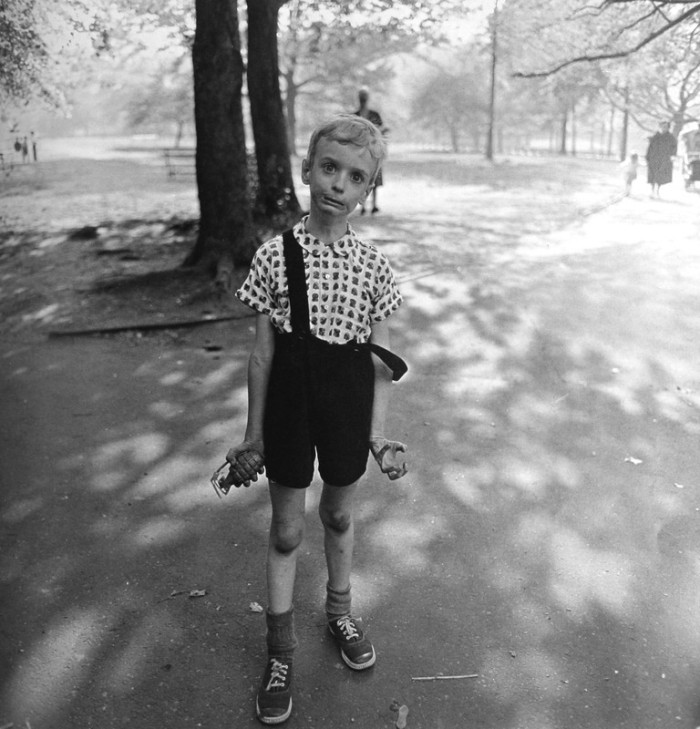
The article on Page 100 in this instance, is not what I am interested in, it is purely the picture. The reason Diane Arbus took this image, doesn't have any connection to what I would use it for. The only part of the article of interest is when the interaction is commented on between the subject and the photographer. Her images always connect the two sides together so the viewer really feels the scene and can look in to the subjects eyes. I like this approach because I feel it would work within campaigning; not the 'look in to my eyes and feel guilty' but the 'look in to my eyes and see how you helping me is making my life positive'. In this image, what is the little boy trying to communicate to the photographer/viewer? Copying the anger he sees in others? Anger at others? Frustration at the life surrounding him? Is he pretending?


© Diane Arbus
Boy with toy hand grenade, 1962, Central Park, New York City


If you saw this image and knew it was part of a raising awareness campaign, what would you think the message was? War children? Dangerous weapons? Violence? How well are you protecting your children? Young fighting in war?

Again, this photograph is black and white like the Migrant Mother, but in this particular scene, the image in my opinion would be much more effective in colour, as it would highlight the grenade the boy has in his hand. Unless you read the image title, you wouldn't know that it is only a toy. The realism of weapons is being drained from the image without colour being present. I want to see the weapon, his dirty knees, the colour of his shoes and the greenery surrounding him. The beauty of a playful child and beautiful surrounding, contrasted with a dangerous weapon that shouldn't be part of the scene.

AIDS Memorial Quilt

I came across this collective community activity whilst reading a book on photographs that changed the world. It wasn't the picture that attracted me in this instance though, it was the idea behind the event taking place within the image that caught my attention.

A HUGE quilt consisting of 40,000 individually handmade quilts was displayed in Washington on the 11th October 1996, to 'demonstrate', fundraise and raise awareness of the number of individuals who fall victim to AIDS each year. Partners, parents, siblings and friends, all created a section personal to themselves and then everything was stitched together. It became known by some as the 'carpet of mourning'. 


As well as being a great way to bring communities together creatively, it rose awareness and gave people a platform and a therapy to help them through difficult times. 

Instead of restricting myself to the information from the book, I found a website dedicated to the quilt and learnt that it is an ongoing event and not a one off like I presumed. The site gives you the opportunity to create a panel for yourself, view the quilt or host the quilt (in America).

The quilt was first displayed on the 11th October 1987, featuring 1,920 panels and covering a spare larger than a football field. It grew from then into the spectacular phenomenon it is today!

What started off as a small idea to bring the issue of AIDS to the publics attention whilst remembering those who suffered as a result, has turned worldwide. Cleve Jones held a march in remembrance to victims and asked each individual of the march to write on a placard the names of the people they have lost. He then taped all of these to the side of a building, which was commented on as looking like a patchwork quilt.... And the idea was born. It started off as small communities contributing, but as word spread, people from all over the world starting sending their panels and visiting the amazing display. 


"The Quilt was nominated for a Nobel Peace Prize in 1989 and remains the largest community art project in the world. The Quilt has been the subject of countless books, films, scholarly papers, articles, and theatrical, artistic and musical performances, including “Common Threads: Stories From The Quilt” which won the Academy Award as the best feature-length documentary film of 1989.
The Quilt has redefined the tradition of quilt-making in response to contemporary circumstances. A memorial, a tool for education and a work of art, the Quilt is a unique creation, an uncommon and uplifting response to the tragic loss of human life." - The Quilt


The fundraising becomes a by-product of the activity. People don't see the money side of the event, they see the contributing to a good cause, remembering the less-fortunate, and spreading the awareness. They enjoy getting involved and being part of something on such a large scale.
I am going to keep this idea in mind definitely and develop it possibly by creating my own event using the general idea. It would be a huge achievement if I pulled it off! Being realistic, I couldn't pull off something on such a grand scale as this (immediately). I would generate a project and build it up slowly, year after year. It is something I need to start thinking about. The more I can get communities involved and creative, the better; especially if it is benefiting children worldwide in the process. At this present time, I have no idea what my idea would be specifically, but I can begin to produce a map of ideas to expand on. Related to photography? Leave cameras in different locations and get people to take photographs what they enjoy about their lives, then post back to me? Create a mosaic of images in the public eye?
This idea has already been carried out in some form, I just can't remember who it was at the minute, so I need to research more in to their development and reason for the project, and then re-create it in my own unique way.

Saturday, 5 May 2012

Mark Webster Tutorial

I met with Mark Webster for another tutorial on the 4th May. It was originally meant to be Monday, but I had to reschedule for Thursday, which then got post-poned by Mark till Friday. We got there in the end! 

I am please with how today's meeting went. I turned up fully prepared and able to deliver what I intended. Being told that I am doing a good job has made me a positive thinker (for now) and given me the determination I needed to push myself further. I had started to doubt myself again and needed reassurance. Well at least I thought I did. Every question directed at me was answered with my research findings to back them up. Mark could clearly see that I'd done my homework and commented on not needing to answer the questions because I was apparently capable of answering them myself.

A couple of days before the initial meeting to ensure everything was organised and clear (to  myself more than anything), I sent an email to Mark confirming we were still meeting, and to briefly inform him of what I wanted to go through during the tutorial. I also sent a copy of my initial proposal, presentation slides and notes, and a questionnaire (which can be answered at his leisure). The reason for all the documents, was to allow Mark to refresh his memory on my project and where I'm roughly up to now. This cuts out the time wasting in the meeting from needing to explain my module again, so we could get straight on to the more important topics.


Aims of meeting:

- Target Audiences
          - Best ways to reach them?
                      - Marketing/Promotion?
          - Relate to personal experiences
                      - Walsall projects

- Walsall Project
          - What do they entail?
          - Audience?
          - Differences made to community?
          - How do you reach audiences?
                      - Marketing?
                      - Promotion?
                      - Campaigns?

- Getting involved in a project
          - Walsall
          - Part of work experience module

- Remind Mark about questionnaire


We spoke about the Fringe Festival and where I am up to on planning the Family Day. I voiced my concern about not having many people on board wanting to contribute and we need to advertise more. Mark wasn't as worried as me saying that we still have plenty of time. Maybe I just like to be too organised? By now, I would have liked to have had all the entries in place and a schedule being set up and agreed with everybody, ready to be published. I also mentioned needing to get the mature students involved too and finding alternative way to reach them as they don't actively participate in many things. Plugged magazine and and the union aren't as successful for that particular audience. After some research, I have discovered that communicating with them through email is the best way to work as that's where they seem to form their community.
Next task... actually get more people on board! I have asked to see Trevelyan to discuss the next step and to go through the proposals we already have. A date needs to be confirmed.


In brief:

- VSO, Regular updates to donor.

- Mark favours positive campaigns.

- Enlist givers as partners.
          - Need to make it seem to them as if you're doing everything together. They donate but      
            you keep them involved. Will hopefully ensure regular donors.

- Many people will want to contribute to a charity if they get to do a challenge.
          - A great marketing concept through friends and family.
          - Family/friends aren't interested in charity, they are interested in the challenge taker.
          - Not long-term investor.

- The challenges attract enthusiastic volunteers, but after the challenge, do they stay on
   board?
         - Need to try and keep them.
         - More challenges?
         - Friends/Family willing to contribute year after year?

- Responsibility on volunteer, not the charity - volunteer is the fundraiser.
         - People could cut out the volunteer and just give the money straight to the charity.
         - As mentioned before, donors aren't giving to the charity, they are giving to the person
           they know. The charity doesn't matter. 

- Word of mouth through people you know is a great marketing tool!
         - Get people talking!

- Get local business to buy advertising in your event/campaign publication.
         - Should become continuous contributors.

- Small charities need local fundraising initiatives.
         - Need long-term donors.
         - Local TV
         - Local Radio
         - Value what I've done.
         - Small ideas need to grow.

- Spoke to Mark about doing a outdoor exhibition in Birmingham.
         - If I have any problems, contact in the Council if needed.

- Mark likes my idea of creating a campaign and not just organising an event.
         - What developments have happened to make this my decision?
         - Reflection.

- Walsall Projects
         - Week of events
         - Asian cultural event: Mellor - 29th or 30th?

- 3 day Art Festival - Sat/Sun/Mon

- Great for networking.
         - People from all over.
         - Contacts!
         - Ask people why they are involved.
         - Create a case.

- Would love me to come along and help.  

- Access to interview people, in return for volunteering at the festival.

- Desperate to get a fundraising strategy.
          - Difficult!

- Mark: When back from Poland, will introduce me to people and make sure I get the most out
  of the experiences.

- Caldmore Village Festival.
          - Poor area: getting community together.


- How do you get local people and shops involved?

          - Constantly kept up-to-date.

- Committee meet every Monday throughout the whole year.
          - Not just a one off.
          - Work all year with other projects feeding in to it.

- I need to keep a Blog and make sure everybody is kept up-to-date on my campaign/event.
          - Progress.
          - Development.

- May 19th - Saturday.
          - Center of Walsall.
          - Leaflets and press coverage for festival.
          - Local radio and papers involved.

- 27th May.
          - Walsall Mellor.
          - Stone lifting.
          - Tug-of-War.
          - Children's events.

- Throughout the whole week of activities: different organisations exhibiting and advertising
  themselves.

- 1st June: 'Get in Day' - All equipment arrives.

- 2nd, 3rd, 4th: Big event.

- Mark promised to answer my questions as soon as he could.

- Answered one on the spot for me.

- Asked me to remind him about sending me more information on Walsall.

- Agreed to arrange another meeting once I had been given the brief for my next module.